Sunday, January 16, 2011

More chocolate with a side of sugar

(Computer is fixed, and even though I'm back home, I had one last blog that never got posted. So, here it is to end my international trip #2.)


I think I've gained weight since I've been in Madrid. In France I lost weight because I ate as little as possible due to the high prices. Here, I've been eating like royalty. As well, in most places, every time you order a coffee, you receive a piece of chocolate with it. So, a cup of coffee with lunch and dinner equals 2 chocolates a day, and then this doesn't include all the other chocolate devoured.

I also never realized how many varieties of chocolate that could be made. In Spain, you have a continuum of chocolate varieties, all depending on the percentage of cacao. The best part is that when you order a cup of hot chocolate, they serve it with a sugar packet on the side for garnish.

With all the sugar, butter and chocolate in this city, I don't know how more people aren't overweight.

Saturday, January 15, 2011

Put the lemon in the Coca Cola...

No pictures can capture Spanish life, and no pictures can capture the beauty and tranquility of Madridians. No photo could show the breathtaking moments that fill my time in the capitol of España.

Spain loves chocolate; it comes in every variety and consistency. They don´t mess around with a cup of hot chocolate either. A cup of hot chocolate is literally a cup of melted chocolate, which they drink as either a dessert or in the manner one would drink a cup of coffee. It is amazing to watch someone sip on a giant cup of dark chocolate as it slowly drizzles down the side of the porcelain mug.

In France it was about coffee and bread, but in Spain it´s about chocolate and wine - who wouldn´t love it here? Everyone who lives here seems to agree with that statement, which is obvious in the way the locals treat tourists. They don´t care, really, if you´re a tourist because they realize for one, we help their economy tremendously, and two, if you are a tourist travelling to their country, then you must enjoy their city at some level. It is because of both these reasons that they try to share their country with tourists as much as possible. "Go see this, go see that..." I went to the museum of natural sciences today, and every time I walked by one particular worker, he would ask, "Did you go downstairs to the right yet?" because this was where his favorite exhibition was located.

As well, almost every waiter will give you their favorite suggestions and will also tell you what mosts tourists don´t end up liking because it is too different from what our tongues are used to. Even better is when you ask, "Hable ingles?" and if they can´t speak English you can see the look of disappointment. This does not mean, however, they will not still try to communicate, and often it turns quickly into a game of hand gestures.

Another way you can see how the Spanish love their country is their awareness toward the environment and recycling. They still use glass bottled Coca Cola and other sodas and waters, and in the morning restaurant workers can be found exchanging empty glass bottles will freshly filled ones with the various distributors. It makes me feel like I am in a time warp to the 1950s. Coca Cola is also normally served with a glass of ice that has one lemon slice waiting for you at the bottom.

In order to make the most of their days (most bars don´t open until about 8 p.m. and dance clubs open after midnight) the Spaniards like their siestas. Thought it´s not as a common as it once was I am told, many places of business close between the hours of 2 p.m. and 5 p.m., where people go home to nap.

Let´s return to the wine. While imported beer is harder to find, wines from all over the world can be found at most restaurants. And a glass of wine is not retstricted to a few ounces such as in the U.S. but is a glass of whatever size filled a little over halfway - there is no regulation in the pour.

In one last note: Americans have this idea that we are the most hated country around the world, and while this may be true when it comes to our government, actual Americans aren´t included in this position, which brings me back to the French. No matter who I talk to, whether it´s the local Madridians or the various internationals staying at my hostel, French people are the first to be made fun of by anyone. After all, while our McDonalds and Starbucks have overrun businesses in most countries, Americans gave the world Coca Cola, so how could we not be liked?

(No picture included in this entry due to problems with my computer!)

Wednesday, January 12, 2011

Buttery men

Politeness and smiles are rampant in Madrid. Prices are reasonable and walking about the city is far more realistic than Paris. The uneven bricks and stones don’t jab into the bottom of my feet as was the case in Paris. Locals in Madrid are happy to help as tourists here are far less frequent. Overall, attitudes are more pleasant—I think I’ve found my city. I could see myself living here, no problem.


The men here are worth noting. Their congeniality makes you fall just a little for each of them, and maybe it’s because they love American women, but I receive compliment after compliment—not in the creepy, annoying way. The men here can be compared to the Spaniards’ love and use of butter. They like butter on everything so they are sure to make it to an exquisite taste; it is always smooth and is often made with some kind of special flavoring, all of which is whipped to perfection…

Parque del Retiro

Tuesday, January 11, 2011

Finding bones and hidden treasures

As I depart through the skies of France and goodbye to the clouds that rest over Paris, I feel relieved to leave. While the stay wasn’t entirely bad (mostly because of the adventures of my last day) I am not sure how much of a desire I have to return to the city. The only time I would make it back here is if I were with my love, and even then I think we could find a better place in the world. The city seems to be so overrun by tourists—even in the dead of winter—that its own local flavor gets lost, or is at least hard to find.


Yesterday, though, I did stumble across of some of this lost culture in the old windy streets where artists such as Van Gogh once frequented. After meeting a Canadian who seemed just as frustrated with Paris as me, and who had no plans on what was also going to be his last day, I asked him if he wanted to join me and my itinerary. He was overjoyed, and as a history major with a particular interest in U.S. history and politics, we had many conversations throughout our day of exploration, while also making fun of Parisians and other tourists. This was all very refreshing.

After going to so many churches, I needed some science in my life, so we went to the Musee de la Histoire Naturelle. The museum at first appeared as if it were a storage center filled with animal bones as far as the eye could see. From primates to frogs and dinosaurs, it was every science lovers’ dream because of the close proximity they allow visitors to go to the current and ancient bones. Many of the bones were those gathered from the famous scientist George Cuvier.

I was the Canadian’s guide as he picked my brain on ancient human history and evolution. I was in the middle of explaining to him the truncated version of humans becoming habitually bipedal, starting with the find of Australopithecus afarensis, when he taps me on the shoulder and points to some bone fragments sitting in a glass case. I couldn’t believe my eyes: Shoved into the corner of this tucked away museum, which it seemed only locals knew about, was the famous Lucy skeleton (pictured left)! “Weren’t you just telling about her?” he asked. I was ecstatic and still get giddy when I think about seeing it.

I couldn’t believe this wasn’t advertised by the museum; it wasn’t even in the guide pamphlet that tells you where some “key” skeletons were throughout the museum. This find made my journey to Paris well worth it.

Now, it’s off to Madrid.

Monday, January 10, 2011

Praying to saints for all the wrong reasons


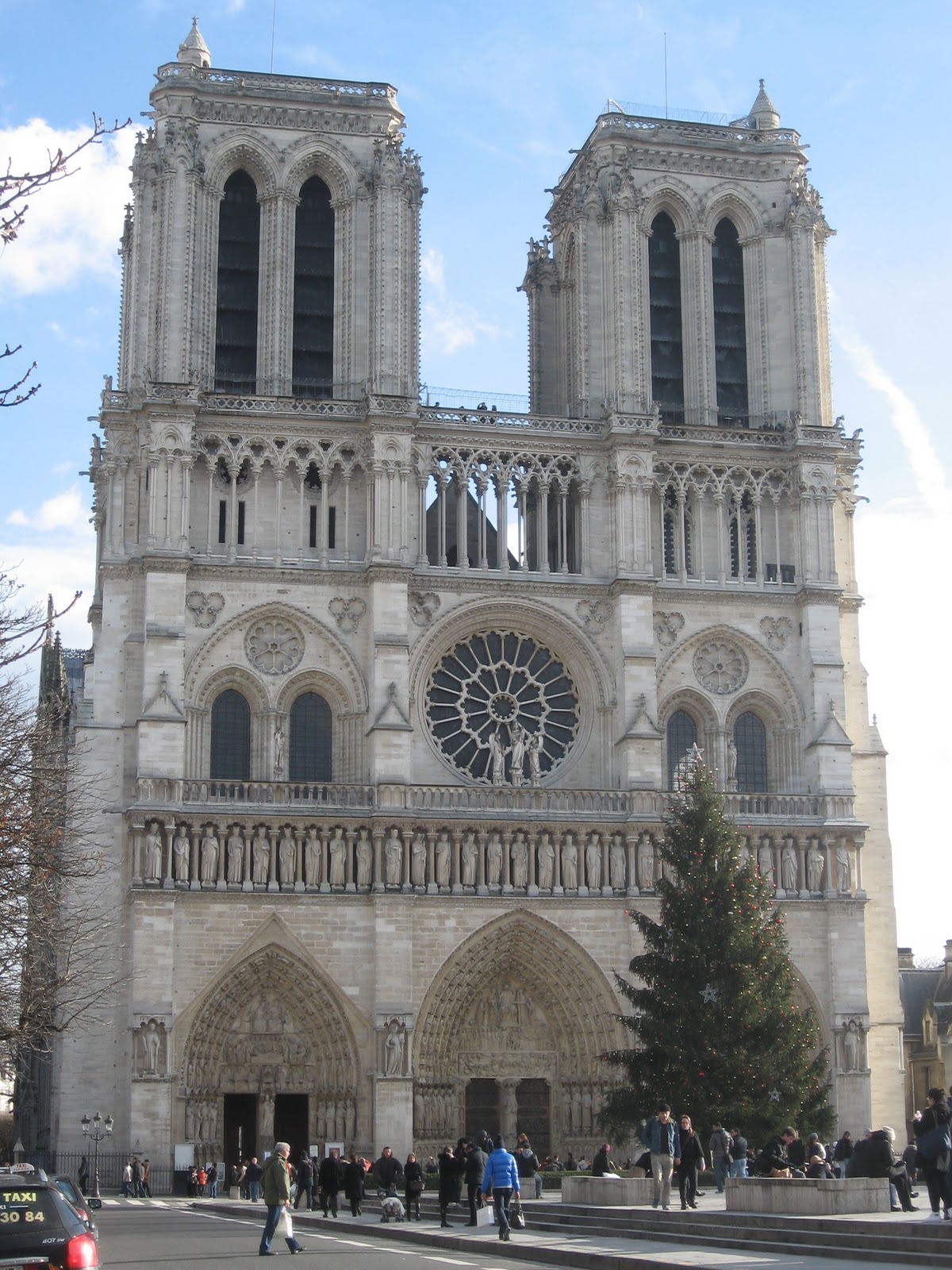
After so many years of not stepping into a church, it’s quite ironic how many I have walked through in the last few days. Nothing was quite like the Notre Dame (pictured above). In fact, I have not prayed in many years, and there was something so powerful about this cathedral that made me feel like I needed to kneel before the altar. It seemed that something so great and powerful begged for my faith, but then I remembered that it wasn’t God who was giving me this feeling, but a material object built by humans.


God never would have wanted us to expel so much into building a monument dedicated to him (though mostly it seems to be dedicated to various saints — which is even more pagan). So, I decided that if I am going to pray again someday, God would not want it to be in such a monstrous place that almost scared me into praying again because then it would not come from the heart.

These extravagant churches and cathedrals are testimony to the absurdity that has become religion, or at least, Catholicism. Jesus was against wealth and those who were wealthy. I can’t then, for all my life, understand Catholicism and how it has oppressed the poor and so many others for centuries. For example, in Paris and I know this happened in England as well, a Protestant wasn’t allowed to be treated by a doctor until they abolished their faith and converted to Catholicism. One of the museums had a list of people who refused and died from sickness because of these religious laws.

Sunday, January 9, 2011

Palin and Napoleon I

In trying not to think about the tragedy that is Sarah Palin and the shootings that occurred yesterday in the states (everyone here is talking about it), I am in instead thinking about fritas (fries). Fritas here are classified as a serving of vegetables — every American’s dream; it makes for a good excuse in eating plenty of them!


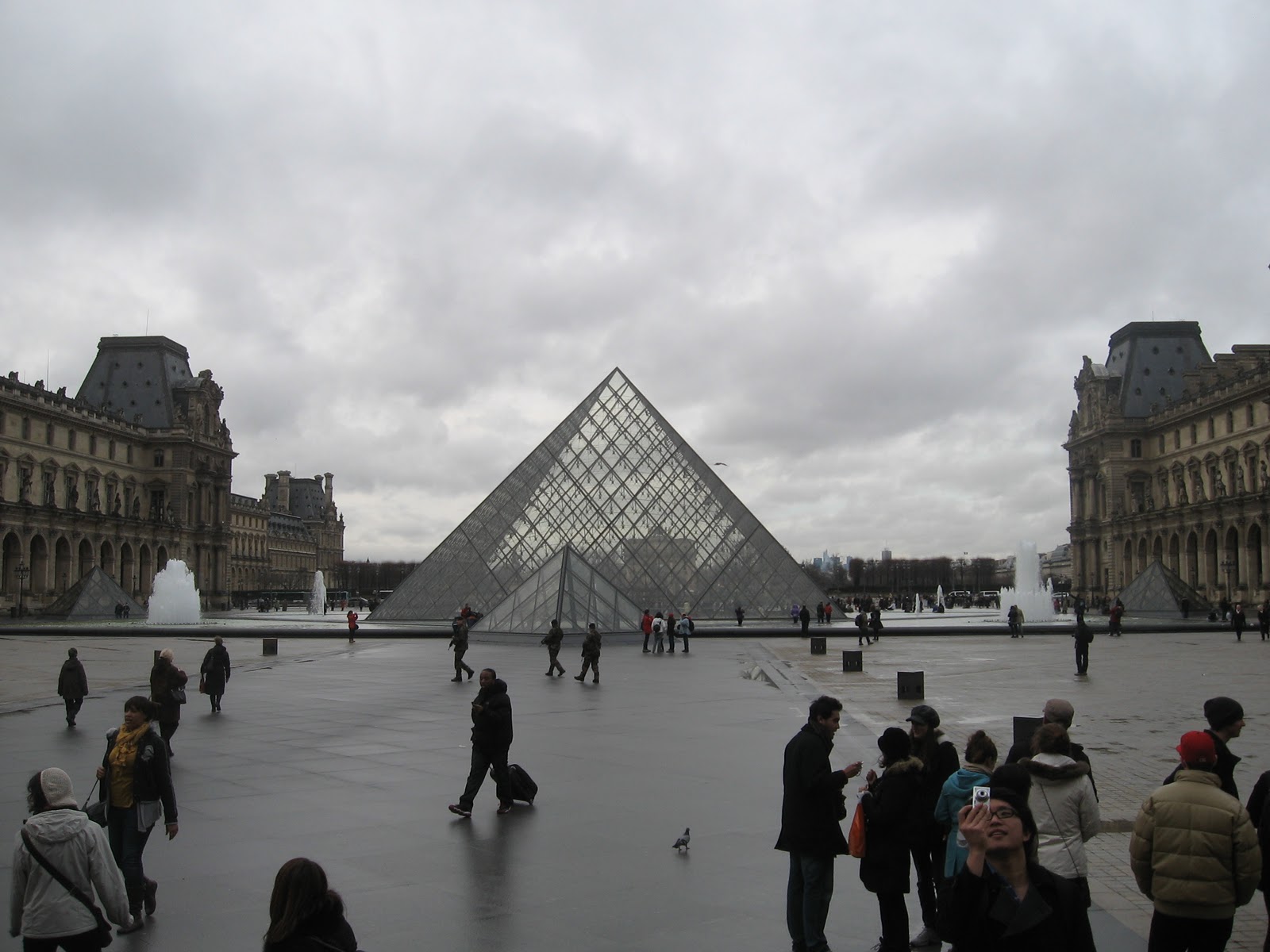
I just finished visiting the Louvre (entryway pictured above), where the Mona Lisa and many other famous artworks are held. Most of the art (including a 3,000-year-old Egyptian piece that once stood in front of the Sphinx that now stands outside the Louvre) became a part of France during the reign of Napoleon I. Most countries will tell you that Napoleon stole most of the art that sits in the Louvre during his days of conquering the world; he “liked” many things. The French maintain this isn’t the case and refuse to give any art back to the respective countries. Egypt, by no surprise knowing how protective their archaeologists are, are the only ones who seem to give a damn and send a letter to the French government every year asking for the return of quite a few items. One item in particular the Egyptians wish to have back is the 3,000-year-old monument that tells the story of Ramses in hieroglyphics. It sits next to the only female statue of the city masquerading as a piece of French history. It’s quite laughable really.

This attitude of reminds me of the American government attitude. In fact, it was after hearing this story that I realized why the American-French relationship is so up-and-down. I have a cousin who is like a sister to me, and we often fight like sisters. My mother always said it was only because we’re so much alike that we fight in the manner that we do. The Americans are like the younger sister to the French — the basic mentality is so similar that we butt heads. We have our versions of the truth that is superior to everyone else — no matter how far it is from reality.

The French government claims the 3,000-year-old monument was given to Napoleon by the Egyptians and find it deplorable that they’re asking for it back. So here are two versions of the story on how this art arrived, but of course the French version is the most illogical. Somehow, though, the French win every year and keep this out-of-place statue that sits in alignment to the Arc du Triumphe and their national assemble; it is truly an odd site to see this hieroglyph sitting between all this French-ness.

Saturday, January 8, 2011

Locking in love

More and more I see how this is the city of “love.” Aside from the bridge dedicated to lovers who attach locks to the wire railing and throw the key of the side into the Seines (the river that runs through the city) as a token of their eternal feelings for one another, menus are dedicated to appetites of two. Couples fill restaurants throughout the day sharing stories, discussing Franco politics — and probably American, as well. If they’re not snuggled up next to each other, many of these couples reach across the table with their hearts in hand, clasping the fingertips of their lover as if they can’t get enough.


And since I’m here without mine, for now I’m enjoying my newfound love: cheese fondu! Where has it been all my life and will I ever find anything so great in the states? I stab the fondue fork into the rock hard sourdough bits and swirl it around in the bliss that is cheese fondue until the bread softens. In between bites I listen to the cackling of the flame and sip my red wine. I don’t know what keeps the flame lit and that captures me even more. The potatoes dipped are good as well, but dry and bland compared to the cheese-covered bread. And once again, all is accompanied by a misty water vase that reflects the pink and red lights of the café.

As the fondue begins to brown (a sign that it’s time to stop!) the rain starts to fall onto the awning before making its way down to the cold, stone sidewalk.

Coffee and history

One of the many statues that adorn the city.

Café. The French know how to make a good cup of joe. If it is not good, then you much not have greeted the server properly upon entering. Tourists think the French are rude, and the French think tourists are rude. To avoid this misunderstanding, all a visitor must do is say “bonjour” upon entering any place of business, whether it’s a restaurant, a shoppe or a pharmacy. Pharmacies here are frequent and from the outside look like a California pot shop with a giant green cross lit up at the entryway that can be seen blocks away.


I sit here eating lunch mesmerized once again by the French present their food — everything is placed beautifully on the plate. Even the water is served formally in a clear glass bottle personally for each table to pout in the mini-wine glass. The food might not taste as great as it is presented, but I think to the regular French customer, this does not matter.

Across the way sits a woman who resembles my grandma Norma strikingly, but I do not know if she was actually French or not. I’ve seen many older French women, who resemble this grandmother and my great grandmother Deary on my mother’s side, who I do know was of French descent. I even smell her around the city, or maybe it’s the overwhelming amount of Catholic churches and holy water that I actually smell. Surely, I have French in my blood, and it’s a curious thought to wonder what distant relatives remain here, or at least connected ancestors of some kind…

I am glad I quit smoking cigarettes before coming here — it would have been too easy to make it a worse habit than it already was. Cigarette packs here read in bold, black letter, “Smoking kills.” in English on one side and French on the other. In 2007, the government outlawed smoking in public places, but I’m not sure what that means because people seem to smoke anywhere. Maybe the law means no smoking inside because that, mostly, doesn’t happen.

Today has been beautiful. Not a drop of rain has touched the ground.


There are several original Statues of Liberties that range in size throughout the Paris.

Friday, January 7, 2011

All is safe

I realized earlier that something I had said to a person in my hostel (thought I’m not sure I actually believed it at the time) couldn’t be more true: If I can do New York, I can do Paris. They say Paris can be a dangerous city, but I feel rather safe here.


I remember my first image of New York at the age of 9 was a ragged man sitting on the stairs to the metro with a stack of wallets. No one seemed to notice that he sat there separating the cash from the credit cards. You would never see anything of the like here as even the thieves have more respect and sophistication in their mischievous lifestyles. Like New York, however, the metro is the breeding ground for crime, which is why at first I thought I would avoid it as much as possible, but now I have other reasons. Paris is not that big. I don’t know the numbers exactly, but it is much like the size of Long Beach. More importantly, why would a visitor want to spend so much time traveling through the city underground when ever rue and avenue has so much amazing architecture to bear witness to?

With that in mind, I understand that part of the “perks” of staying in a hostel is getting to meet people, but I’m not here to make lifelong friends or to have sex. I hope it was just this one Brazilian who seemed to think it was okay to lecture me about traveling with a boyfriend at home as if hostels are for a place of “hooking up.” Can it just be that I’m a tight-budgeted traveler who wanted to visit this city since I knew of its existence? As well, I do not need a short companion to enjoy what I want from any city, and I think this man’s addiction to that is quite sad. For a city of “love,” these travelling men don’t understand the idea of fidelity and the sanctity of love.

I have lived alone since 20 — I am not one who needs others surrounding me to enjoy life. In fact, I get more joy observing from the outside, such as this moment while I write. I’m sitting alone nibbling away at my pizza as I take moments to watch the workings of the restaurant, giving the occasional smile and nod as necessary. My peace is sitting here alone without having to engage in conversation, and listening to every murmur around me; these are things I wanted to come to this city — and any place for that matter — to witness, and how can one do that without observing?

We could all maybe learn a few more things about each other if we stopped our mouths and opened our eyes wider. Infants are capable of learning so much their first couple years of life. Granted, much of this has to do with biology, but maybe it also has to with their inability to talk. When one isn’t using one of the senses, the others are heightened. Who is to say that speaking can be included in this theory?

The top photo is of the military grounds (which includes a Catholic church) and the photo above is one of the many different types of metro entrances.

Fashion, rain and cigarettes


It is wet. Like the sun acts for cheery Californians, the rain suits Parisians well. It is relentless and sophisticated the way it runs down the intricately placed cobblestones of the streets. The rain is always rushing to go some place, and it only has one form. Unlike the rain, though, Parisians do have a smiling place beneath their flat-lined lips — their expressionless gaze that makes one assume they’re unhappy. They hide this place of cheer behind their cigarettes and cups of espresso, and behind their language of formality. In France, the Parisian happiness rests inside the bars, where some laughter can be heard, and inside the chocolate shoppes, which are as frequent as 7/11 and Starbucks are in the U.S.


Scarves, silk, extravagant boots and jackets — Paris is not much for the ill-fashioned. Without these you are clearly the backpacking visitor or the poorest Parisian. There isn’t much color except the occasional red.

Women seem to dominate the city. This aspect may be my favorite of Paris. Men push the baby strollers and are often seen feeding the infant and cooing them. One would think this is a matriarch, though I am sure it is not.

Thursday, January 6, 2011

International trip 2: Paris and Madrid

I have decided to convert my old blog into a travel log for journeys throughout my life. This is not for professionalistic purposes, but is for myself and those who care enough to read.

Friday, June 19, 2009

Reflecting on science and environmental writing and the Amazon

The top things I learned or was reinforced to acknowledge as a science writer:

1. Pay attention to the money. When a new grant is received then there is probably some kind of progression happening in that field or particular research project. However, conflicts of interest must be paid attention to once writing the article. Who is giving the money? A pharmaceutical company or a nonprofit organization? Who came up with the research topic? Who is writing the report? What connections do the researchers have with any corporations/business ties?

2. Pay attention to the tools. New discoveries are made every day in science and the environment, so in order to help narrow down what is “newsworthy” a reporter must pay attention to new tools and devices used to make that discovery—sometimes the discovery itself is not “newsworthy.” For example, a new way to splice genes or to examine the different proteins would be a story worth covering.

3. Pay attention to the methodology. Conflicts happen every day here, even in peer-reviewed research articles. Understand statistics and the different between causation and correlation because many times it is hard to really isolate one factor as the main cause for something. A writer must look at everything holistically to understand the significance of a study, or lack thereof.

4. Understand embargoes and how strict they are with different science journals. The integrity of the reporter and scientist can be threatened if a journalist breaks an embargo.

5. Understand what “getting both sides of the story” means in science writing. Because many time you’re dealing with hard facts that aren’t subjective and don’t change depending on the scientist, you don’t have to put a creationist theory in every single one of your stories, for example. Though, it is important to know of any critical scientists who can shed more light on a subject. Always have multiple sources and multiple explanations from different scientists who are knowledgeable on the subject.

6. Keep in mind the structure of the story since many people find science too difficult to understand. Remember the AB-BC-CD structure to help you formulate a clean and straightforward article that your readers will understand.

The top things I learned or was reinforced to acknowledge about the Amazon:

1. Deforestation: there are many aspects to this issue in the Amazon that do not seem to be fully explained in most articles I have read. For example, because Brasil is an export-driven country people must realize farmers and ranchers aren’t slashing and burning forests here still simply because they are too stubborn to change their ways. They have no other way to produce an income, and people in developed countries are consuming these things—it’s hardly even the people here supporting such expensive resources. The government also has difficulty in enforcing regulations and environmentally friendly policies because it is more of a socioeconomic issue. They must be able to provide jobs to these farmers and ranchers before being able to tell them they must discontinue their form of income.

2. While there is a disproportionate distributing of wealth here it is much more extreme than the United States. But what is completely different from the United States is that beyond the class differences, there is an uneven distribution of information.

3. What happens when “exotic” products like the açaí berry goes into an international market, and what happens to the available nutrition to the lower classes here when a once cheap and healthy food is shipped everyone else in the world. The price is hiked up and it quickly becomes the rich-man’s food.

4. There are efforts being made here by the military to relocate border-living indigenous people because it for some reason believes they want to secede from the country of Brasil. Anthropologists studying these tribes, however, say differently.

5. Yellow fever and leprosy: considering it’s not even a requirement to get the yellow fever vaccination before traveling here, it came to a surprise to me that there were almost 60 confirmed cases last year. Both of these diseases, as well as many others, are still major problems here even though huge efforts are made to disseminate vaccinations.

Thursday, June 18, 2009

Day Onze: New paths are shining

The clouds come over way, casting dark lines upon the golden beach and brown-tipped waves of the Amazon River. The sun had been beaming, poking itself out of the white pillows of the sky until violet rain clouds push our way. I wander around taking picture after picture from every angle of the river’s last beach before it opens up to the Atlantic Ocean. I know this was one of the last moments I could capture of a forest that has grown so close to my soul over the past two weeks. When will I get to come back here, I wonder. When will get to lay my eyes on this wide and mysterious river again?

I sit in silence while the others go about their storytelling and last-minute bonding. I only want to bond with the various palm trees and brightly colored rocks tumbling ashore by the gentle river waves. And then it begins to rain.

On the way back to the city I watch the bicyclers trudge through the heavy chuva (rain) but with it being such a daily occurrence, the rain doesn’t bother them. I’m glad I enjoy the warm rains here and houses built on stilts and children kicking cans with their feet and sticks. Life is so simple. Everyone puts their hands to work here — no one is left sitting.

The downpour turns into a drizzle. The rain comes and goes faster than the people drive here, which is a difficult feat. My return someday will hopefully not be long from now and my stay here has only encouraged the achievement of my dreams. No longer do I feel I pressure myself to accomplish too many things or that anyone else does for that matter. These dreams are my goals because I am going to reach them. They are not too far off or impossible — this is my choice.

I feel a knot forming in my throat and emptiness in my stomach. I do not want to leave but I know this journey has only been a confirmation of my abilities to expand my mind, maybe even to overachieve (as some say I do too often). This world, I decide, needs overachievers. The bricks do not get laid by themselves — there must be someone willing to do the stacking; someone to pursue the direction people say they want but don’t choose. They just continue on the already-trodden road because much less work is necessary. Your life’s work is the legend you leave, and whether few or many know of you or your legend, as long as you make one then, to me, life is worth living.

The drizzle ends and the sun makes its way from behind the clouds and dries the red soil and brown skin of the cyclers. The sun always prevails. I begin my legend.

Wednesday, June 17, 2009

Day Dez: From dirt to pavement

It’s the classic saga of industrialization: the formation of trade routes, logging and mining routes that eventually become dirt roadways, to paved highways. While the questions arises of which came first the industry or the road; one must keep in mind the history of each area in Brasil to understand the relationship between road construction and industrialization. In Northern California, for example, there are a few preservationist groups who would like to blockade some of the old timber logging roads, but what good would this do since the roads aren’t even used for this industry in the same scale as 15 years ago. Now the road is road, hikers, campers and hunters use the road. Firefighters use the road. Northern California’s road situation is far different from that of Brasil’s, however.

Paving roads in Brasil means the threat of access to those who shouldn’t necessarily be accessing it. It means further access into the Amazon Rainforest that grilagems (people who squat on a piece of land and use it as their own and then attempt to sell the land to someone else) will use to exploit or other poachers of all sorts. As Peter Mann de Toledo, the president of the Institute of Social and Economic Development of Pará and former director of the Museu Paraense Emilio Goeldi (pictured below), as soon as the government supports paved road development many see it as an opportunity to do some development of their own. “It’s a new El Dorado,” he said where all of sudden people are running out and searching for the treasure.

Mann de Toledo also discussed the change in land development from 20 to 30 years ago in Brasil to what is encouraged and used today. Below is a picture the methods used before more regulations were set in place. The corridor is the forest, usually along a water source, with small patches (the mancha) of forest surrounding the greater matrix where the road and resource production/harvesting took place.

Today the 80/20 law is followed more strictly (where 80 percent of the land is set aside for forest conservation and 20 percent is used for farming and/or ranching). Now the corridor is the road in and out, the matrix (the larger parts) is forest left untouched and the mancha is the cleared area for land development. Below is an example.

Tuesday, June 16, 2009

ARTICLE 2: Squeezing out the açaí berry's juice and money


It’s purple, small and round, grows in the Amazon and is an example of Brasil’s continuing trouble with resource sustainability in regards to fairness to the economic system, small farmers and the environment.

The açaí berry from the açaí palm tree is a fast-growing staple of Brasilian exports to countries like the United States where it is used in beverages and hyped as a “superfood” stuffed with antioxidants. There is no actual evidence, such as review by the FDA, that it harbors such massive amounts of nutrients.

In her presentation “The Forest for Who?” the director of the Museu Paraense Emilio Goelde in Belém, Pará, Brasil, Ima Vieira, an ecologist with a specialty in degradation, cited the recent influx of açaí as “a management opportunity to produce without destroying.”

Because of the berries popularity as an export the price for rich berry has been increasing. Vieira said before it became a celebrity, for one liter it cost local Brasilians 1-2 reais, which is equivalent to 50 cents to $1 in the U.S.

Now for the same amount it costs 10 reais for locals, or about five U.S. dollars.

The berry production going international has also encouraged deforestation, an already hot topic in a timber and mining-reliant nation. Instead of farmers managing a diverse area of vegetation per one hectare, Vieira said farmers are clearing any land below the palm tree so all of the soil’s nutrients are driven to the açaí — an economic encouragement for farmers to maintain one type of tree per hectare, thus decreasing the biodiversity as well.

According to a March 2009 New York Times article, 53 new food and drink açaí products were launched in the U.S. in 2008, where it was only four products in 2004. The article also states that according to Spins, a market researcher specializing in natural products, açaí-product sales exceeded $106 million in 2008.
While the government requires users of the land to use only 20 percent of their allotted land and to keep the other 80 percent as a conservation unit, most farmers, Vieira said, do not follow this regulation for any resource harvesting. While the state of Pará, for example, has enforced fines and the threat of jail for over-deforestation, it is not easily regulated. Municipal governments are said to look the other way in some cases because of the economic benefits harvesting the land can have for a community.

Day Nove: No more silence

Sustainability again. It seems to be the most difficult task for humans to achieve — maybe it’s because there are too many of us, maybe it is because we are egocentric. Whether it is harvesting timber, fruit or mining, the Amazon is constantly being deforested. But how do you tell almost a majority of its inhabitants of the land who are living below the poverty line to stop their way of life and to cease their modes of survival. What jobs do we give them? Where do they go to make a living? What will they eat and drink? What will they tell their children who are already forced to grow up at an earlier age than most Americans?

The United States — while it is in a similar situation but largely downsized — it is by choice because of a green and environmentally friendly conscious developed countries have the wedge room to make. A swing from fossil fuel production to biofuel, for example, is underway because the U.S. government, particularly since the end of the Bush Administration in November 2008, has realized that the resources we rely on to use and for jobs are being depleted. The Obama Administration has made clear a shift that is necessary to make. While it is not a smooth shift and people are losing their homes and feeling the backlash of our years of dependence on limited resources and exploited sustainable resources, in the long run it will be an improved and updated America to fit our global and environmental circumstances.

America doesn’t help, however. In fact, we are a huge contributor to the problems areas like the Amazon face. We are the consumers — an import-driven country. Would we stop producing huge blockbuster Hollywood movies if someone told us that for whatever reason it was hurting their balance between the environment and their daily health? No, the films make too much money for those who are in control. We don’t have to face those imbalances in our cushy lives so why should we care?

While we are pushing everyone to be environmentally friendly we continue to consume, we’re just outsourcing what we are consuming, so it doesn’t look like it’s so bad here. Countries like Brasil then become exploited because they need the money — they have what we want, and we have what they want — it seems like such a simple exchange. But then, all of a sudden, the land is unusable, so they must find other land where soon after, the cycle repeats and more land is needed. And more. And more.

And we continue to pay them off for their exotic goods, for their unknowing silence, their soil and dreams.

Monday, June 15, 2009

Day Oito: Yellow fevering

I wish I had received the yellow fever vaccination after today. While interviewing Elisabeth Santos, the director of the Ministry of Health at the Evandro Chagas Institute under the Sectretariat of Surveillance in Health located in Belém, Pará, Brasil, I began to feel an ache in my stomach. Santos doesn’t understand why it’s not a requirement for tourists to receive the vaccination since confirmed cases are still reported on — 59 last year in fact.


The indigenous peoples here are an interesting facet of the country whether it is a discussion about disease, land use or supposed secession. The military here, according to another person we interviewed at the Museu Paraense Emilio Goelde, Claudia Lopez a researcher and anthropologist at the park, seem to think that indigenous lands (similar to that of reservations in the United States) hope to secede from the country of Brasil and make all the efforts they can to relocate these peoples to another location other than country borders. Anthropologists, she says, working with these indigenous groups have no motivation to discard Brasil as their own.

As far as disease and the indigenous people, according to Santos, they are pretty accepting of Western medicine when it is available to them, but that the spiritual healing part of their tradition is not ignored either. She said that usually the local healer has just as much say in treatments as those who are visiting to help. She said that once contact is made consumerism and Western materials are too hard to avoid but that traditions are still observed. If they weren’t still observed then they probably wouldn’t have any desire to stay as remote as they do — they would just move to the city or the suburbs.

Sustainability is also an issue here as it is anywhere else in the world. Figuring out a balance between deprivation and preservation so the environment and those using its resources can both come out as winners is not easy. There are always differing opinions out there, especially when it has to do with the use of resources. Some ask why not just do reforestation where deforestation as occurred, however with nutrient-lacking soil in Brasil this solution is not so easy, besides from the fact that once deforestation occurs, the biodiversity in that area has already been affected. Part of why so much deforestation has happened so rapidly in Brasil is because the land is so infertile that crops do not persist efficiently in the soils for very long, maybe around 5 years on average, so new land is constantly required. While this was not discussed at any of the lectures, legumes are being used around the world as a long and short-term solution to this issue. Education of the advantages to planting legumes with crops is still underway and while it is not a new plant the widespread use for soil sustainability is only at its beginning.
After purchasing more Brasilian-like clothing and getting my hair braided people have been staring at me less, and seem more shocked that I do not speak Portuguese. I like this comfort; it makes me feel less likely to be mugged because it is not so obvious I am American. Once I return to the states, however, people will probably stare at me because I have braids!

Sunday, June 14, 2009

Day sete: Where are the bathrooms? (and VIDEO)

I plan on rocking out with my anaconda-skin tamborim (tambourine) as soon as I get back to the states. I don’t even know where to go from here in the blog entry because how do I top that sentence?

Today was the Festa Junina commemorating São João (Saint John). It is also the celebration of Saints Anthony and Peter. Thousands of people gathered at the Docas to the march toward the center of the city to the Belém Plaza, where a concert and hundreds of vendors were set up with all types of local goods. While marching everyone follows a brasilian folk band and everyone swings to the music. The colorful streets and music rushed to my feet and hips and I couldn’t stop dancing as well.


Spending the day with some students at the college we’ve gone to a couple of times for lecture was a true cultural integration. While they showed us around the festival and told us other things about Belém we did not yet know about, they asked us an infinite amount of questions that I loved answering. It was also nice to hear that the youth here are not nearly as apathetic as the adults — just like Estados Unidos. One conversation with Uriel, one of the males in the group, was of the most interest to me: men using the sidewalks and building walls as urinals. He hates it and the way it makes certain areas smell like human piss while walking down the sidewalk. I’ve come to learn those aren’t just dirty puddles — they are piss puddles. Public restrooms don’t really exist here, so as a woman you are out of luck, and as a man if you have anywhere you please because it is not illegal to pee in public. When I told him about the strict laws regarding this topic in the states he said he wished the state of Pará would do the same because he said he knows that would be the only way to fix the problem. He said it is embarrassing when people come here only to find corners and random walls smelling of piss all over Belém. Now I really am sure to wash my feet upon returning to the hotel.

Saturday, June 13, 2009

Day Seis: Swimming in the Amazon River (and VIDEO)

No, there weren’t any anacondas around or other obscure creatures in the water—the only animals that seemed to be around were stray dogs. Today, I swam in the Amazon River after an hour to two-hour boat ride to this remote island near Belém. It was not part of our class, but something we all decided to do. This day quickly became one of my favorites once we landed onto the island and got to walk through some parts of the forest — an up close and personal look at the real Amazon.
As I lay out in the sun after taking a dip in the shallow river, I could hear drums off in the distant from some neighboring house. There are small communities on the islands, of course, and the travel by bicycle and dirt bike along the river’s edge. The boat we took also helps supply the people there with whatever goods they need as they throw out plastic bags out onto the river where different canoes of sorts standby waiting for the goods all along the river. Some houses are on stilts and I am unsure of accessibility to electricity—in most places it seems unlikely. Generators are probably used only when necessary.
I made some friends after being bold enough on the boat ride to get up with the dancers and bust some moves with them. They all complemented me on my dancing via sign language and what English they did know. Brasilian men know how to dance, which makes me think this is where I belong!

My skin hurts. As many times as I liberally covered myself in sun block, I am still a fried banana. The quest for aloe vera once we got back was the most interesting, but then again people here don’t sunburn it seems really. A climate of year-round sun keeps their pigment protected against such irritating skin. I finally found some aloe vera/mint concoction at Big Ben—which is located all over Belém. Big Ben is a strange little store. It is like a mini-mart in some ways, but is more like a pharmacy in reality. It doesn’t sell water or snacks and it doesn’t sell cigarettes, but if you need condoms, baby wipes, shampoo or some Guaraná soda (Brasilian soda which is, ahh, way better than any sodas in Estados Unidos) Big Ben is the place to go.


Friday, June 12, 2009

Day Cinco: Jesuits and Cannons

There are two institutions that have dark architecture many times used to scare its viewers: military establishments and churches. Oh how I wish I could have taken photos inside the oldest church of Brasil at the Complexo Feliz Luzitȃna, which is an entire complex that formed the cities first buildings: The Nativity Fort, House of the 11 Windows, the Cathedral and the Church of Saint Alexander (the oldest church).

All of the carvings and sculptures of different saints and “nossas senhoras” (our sisters) and lets not forget Jesus himself, while they are intricate and amazing historical artifacts, are intimidating and strike fear within any onlooker. Then one walks over to the fort and the cannons there have the same type of effect. Early to mid-17th Century art and architecture is apparent here in Belém against any of the newer buildings, though mostly everything here is older. Below is the Church of Saint Alexander.


The church is no longer used as such but is strictly a museum and sometimes a classical music venue. There was an entire room filled with silver artifacts. Silver gauntlets, crowns, spoons, etc. -- all of the extravagances of the Portuguese Jesuits who forced the natives in Brasil, after training them of course, to carve and build the fortress, church and cathedral. The amount of carving and building that had to be done took almost twenty years to complete. Then they forced the natives to attend these churches for fear of punishment. Religion is a very dark part of human history and sadly by our choice continues to be — it has only caused death and tragedy. Below is the cathedral, which is currently under renovation so we could not enter.

Hits